The taper method · Alcohol
How to drink less — a gradual taper that doesn't need a rock bottom
There's a huge space between "fine" and "rock bottom" that almost nobody talks about: the nightly two-or-three-glasses groove that costs you sleep, money, and sharp mornings. You don't need a dramatic sobriety date to fix it. You need this week to be slightly lighter than last week, on purpose, with receipts.
Why cold turkey keeps failing you
All-or-nothing thinking is the native language of drinking culture — you're either "drinking" or "sober", and the first glass after a dry streak reads as total failure, which conveniently justifies the fourth. A taper deletes that trap: the plan expects you to drink today. Just one less than the old you.
Evenings are also wired with cues — the pour while cooking, the couch glass, the Friday round. Tapering unstacks them one at a time, and spacing does quiet work too: a drink at 7 and one at 9:30 lands completely differently than two by 7:45.
Step 1 — count, don't judge
Count honestly for one week — every beer, glass, and pour counts as one (be honest about heavy pours; a half-bottle of wine is two and a half glasses, not "a glass"). Most people land higher than their mental estimate by about a third.
Say it's 4 a night. At $8 a drink out (or $3 at home), that groove runs $70–220 a month — worth knowing while you decide where your floor is: zero, or a weekend-only two.
Step 2 — the curve does the quitting
A taper is arithmetic: today's target is one notch under where you started, and every day steps down a little more until the finish line you chose. What a real curve looks like:
The spacing matters as much as the count: spread today's number across your waking hours and the gap between sessions grows on its own. That's the entire trick — the space does the quitting, not your willpower.
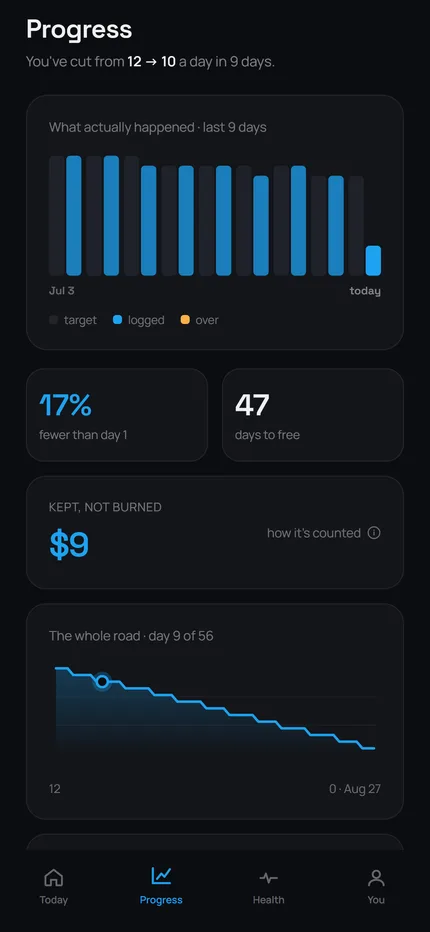
Cadence runs this exact method.
It builds your curve, paces every window through your real waking hours, pings you the moment the next one opens, and keeps honest score — including the money you stop burning.
The hard minutes
The witching hour is usually 6–9pm — the transition from work to home, when a pour is really a request for a gear change. Give the hour a replacement ritual first (the walk, the shower, the good soda in a real glass) and the count gets much easier to hold.
Social nights: decide the number before you leave the house, alternate with water, and remember nobody is watching your glass as closely as you think. Going over happens — log it, hold the week's target instead of stepping down, and carry on. A recorded over-night is a bump; a hidden one is a relapse story being drafted.
Fair questions
Is it safe to stop drinking cold turkey?
If you drink heavily every day, abrupt stopping can be genuinely dangerous — alcohol withdrawal can escalate to seizures. That's a clinical taper, planned with a doctor. For moderate drinkers, a gradual reduction like this one is the gentler path in every sense. When in doubt, ask a clinician first.
Do I have to quit completely?
No — that's the point of choosing a floor. Plenty of people taper from four-a-night to a deliberate weekend two and hold there happily. The win is that the number is chosen, counted, and yours — not whatever the evening decided.
How much money does drinking less actually save?
Arithmetic, not magic: two fewer $8 drinks a night is roughly $480 a month, $5,800 a year. Even the at-home version saves four figures. Watching that number grow daily is one of the strongest motivators there is.
What counts as one drink?
One 12oz beer at ~5%, one 5oz glass of wine, or one 1.5oz shot. Count doubles as two and big pours honestly — a taper built on undercounted units is just the old habit with paperwork.
Not medical advice. If you drink heavily every day or have had withdrawal symptoms before (shakes, sweats, morning drinking), plan your taper with a clinician — stopping abruptly can be dangerous. In the U.S., the SAMHSA helpline (1-800-662-4357) is free and confidential.