The taper method · Caffeine
How to cut back on caffeine without the withdrawal headache
Caffeine is the habit everyone jokes about and nobody takes seriously — until the 3pm crash, the 1am ceiling-stare, and the small print that you can't start a morning without a can. Quitting cold gives most heavy users a two-to-nine-day headache. Tapering skips the headache almost entirely. This is the gentlest quit on this site, and the fastest.
Why cold turkey keeps failing you
Caffeine withdrawal is real and predictable: headache, fog, and irritability starting 12–24 hours after your last dose, peaking around day two. Its severity tracks how big the drop is — which is exactly why stepping down 20% at a time barely registers, while stopping outright flattens you.
The habit is also schedule-shaped: the wake-up cup, the commute can, the post-lunch rescue. A taper retires the low-value doses first (you know which ones are ritual, not fuel) and keeps the one that actually matters until the end — or forever, if a one-cup floor is your goal.
Step 1 — count, don't judge
Count for two days: every coffee, energy drink, strong tea, and pre-workout counts as one. A "cup" here is a normal mug or one can — a venti or a 300mg monster honestly counts as two.
Say you're at 5 a day. That's roughly 500mg — and if two of them are bought, about $10 a day walking out of your pocket for the privilege of sleeping worse.
Step 2 — the curve does the quitting
A taper is arithmetic: today's target is one notch under where you started, and every day steps down a little more until the finish line you chose. What a real curve looks like:
The spacing matters as much as the count: spread today's number across your waking hours and the gap between sessions grows on its own. That's the entire trick — the space does the quitting, not your willpower.
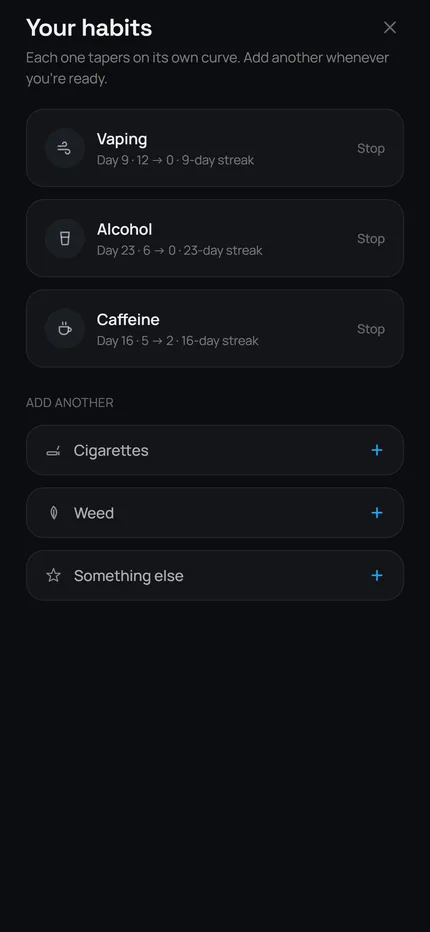
Cadence runs this exact method.
It builds your curve, paces every window through your real waking hours, pings you the moment the next one opens, and keeps honest score — including the money you stop burning.
The hard minutes
The 3pm slump is the boss fight, and it's partly caffeine's own doing — the crash is the rebound from the morning doses. Ten minutes of daylight, water, or a short walk covers the gap better than the fourth cup ever did, and after a week at the lower level the slump itself shrinks.
Headache creeping in? You dropped too fast — go back up half a step (yes, on purpose) and descend slower. Half-caf is legitimate tapering technology: same ritual, half the dose, zero drama.
Fair questions
How long does caffeine withdrawal last if I quit cold turkey?
Typically two to nine days, with the worst around 48 hours — headache, fatigue, fog, and irritability. A gradual taper of roughly one cup every three to five days avoids most or all of it, which is why it's the standard recommendation.
Do I have to give up coffee completely?
Only if you want to. Many people taper to a one-or-two-cup floor before noon and stay there permanently — that dose delivers most of the benefit with little of the sleep cost. Set your floor above zero and the plan holds you there.
When should my last caffeine of the day be?
Caffeine's half-life is five to six hours, so a 4pm cup is still half-active at 10pm. Moving the last dose before 2pm is the single highest-leverage change for sleep — most tapers feel dramatically easier once sleep improves, which makes this a great week-one move.
Does tea or decaf count?
Strong black tea is about half a cup-equivalent; count it if you drink a lot. Decaf (2–7mg) is effectively zero and makes an excellent stand-in for the ritual doses — same mug, same warmth, no debt.